Find out what is slowing your store down.
Paste any page. In about four seconds you get every third-party script it loads, which of them stop working in March 2027, and how that page performs for real visitors — not for a test tool on a clean machine.
Free · no sign-up · nothing stored
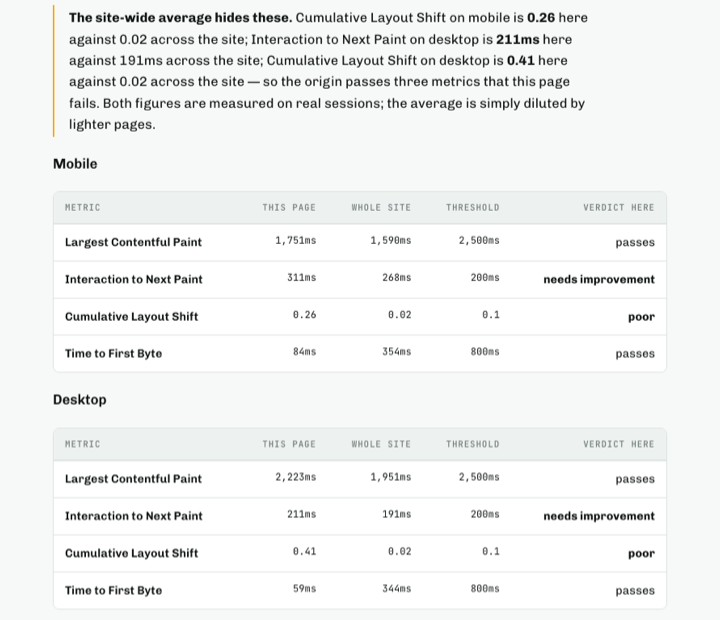
Real output · a store whose site-wide average looks fine
Three things your analytics will not
Which page is actually slow
Google grades your whole origin, so one heavy template can fail badly while the average still reads as fine. We show the page you asked about next to the site-wide number, and say plainly when the average is hiding something.
What breaks on 1 March 2027
Shopify stops injecting script tags on that date. Anything still loading that way goes quiet — no console error, nothing that fails a build. We list yours, by vendor.
Who is hiding behind your own domain
Vendors sell first-party subdomains so ad blockers do not catch them. We resolve every subdomain through DNS and tell you which ones are really someone else's code.
What it does not cover. The instant check reads the HTML of one page. It cannot see what a tag manager injects afterwards, or what only appears once someone accepts a cookie banner. For that we load the page in a real browser and email you the full list — also free, and the only thing on this site that asks for an address.
Script tags stop being created in days, and stop running in 2027
| Date | What changes | Warning |
|---|---|---|
| 1 Oct 2026 | No app can create or update a script tag | error returned |
| 1 Mar 2027 | Shopify stops injecting them onto storefronts entirely | silent |
The second one is the problem. Analytics, attribution, chat and returns widgets simply stop executing, and nothing tells you — not a console error, not a failed build, not an alert. You find out from a reporting gap weeks later. Shopify's documentation →
Look for free. Pay to watch.
Check
See what is on the page.
- Every third party the HTML references
- Shopify script tags and their 2027 exposure
- Vendors disguised behind your own subdomains
- Core Web Vitals for that page and for the whole site
Report
Why each Core Web Vital is where it is.
- Two Lighthouse runs read against real-visitor data
- The element, the wait and the app behind each number
- Every finding labelled by how much was measured
- Emailed as a private link from any check result
Monitor
Know which app is slowing each store you manage.
- Every store's templates measured daily
- An alert when an app appears or a metric moves
- History against the real-visitor record
- Reports with your name on them, 14-day trial
Nothing here predicts a number. Monitor measures real visitors before and after a change, so you can see whether it held — see what each one is not.
Product-page LCP was landing anywhere between 1.0 and 6.4 seconds, run to run
It was not image weight, and no amount of compression would have moved it. React was discarding the server-rendered hero image and re-mounting it, so the browser measured the remount — sitting behind roughly forty blocking scripts that made boot time unpredictable.
of Shopify storefronts carry script tags that stop loading on 1 March 2027
We measured 2,123 storefronts. Two samples drawn on opposite principles — a directory of established merchants and a random draw from a long-tail rank band — landed within four points of each other. 37% of large stores are double-loading a vendor right now, which is a script tag that can be deleted today with no vendor dependency.
Before you paste a URL
Do you need access to my store?
No. Everything on this site is measured from outside, from public sources — the page's own HTML, the Chrome UX Report, and DNS. No app to install, no collaborator account, no API key.
Does this work on themes, or only headless stores?
Both. The check reads whatever the page serves. A headless storefront emits no Liquid loader, so it shows zero script tags — which is correct as a statement of exposure, and misleading if you read it as a platform label. We say so on the result.
My store is small. Will there be any data?
The third-party list always works. The Core Web Vitals half comes from Chrome's own dataset, which needs enough real traffic to report — below that threshold you get the script inventory and an explicit note that field data is unavailable, rather than a made-up number.
Is it really free, and what happens to my URL?
The instant check is free, unlimited and needs no account. We keep the domain you checked so the vendor database improves, and nothing else — no IP, no user agent, no identifier. The deep scan asks for an email because we send the result there. See the privacy notice.
Will you tell me how much faster my store will get?
No, and be careful with anyone who does. We report what is measured now, what changed after, and which fixes the evidence supports. Forecasting someone else's number from a case study is how performance vendors get themselves in trouble.
Do you work with agencies?
Yes, white-label. You keep the client relationship and the report goes out under your brand. Details on the pricing page.
See what is on your store right now
No account, no password, no card. Paste a collection or product page — the templates that carry your revenue are usually the ones worth looking at.
Who does the work
here
Andrei Alex — senior frontend engineer with over ten years on high-traffic commerce: React, headless Shopify, and the render-path work that decides Core Web Vitals.
One engineer, not an account manager. You talk to the person writing the code, and the invoice comes from a registered company. More →